Approximate collision and inside-outside on the CPU, straight from the descriptor
Updated 2026-10-30 16:24; study: ~/code/data/meshes/fcp_2910_collision (sections/collision/README.txt).
Package v5.5 (commit 7ccd2a39, parts="tracked-fit", interp="poly"). 12 objects (household: mug, mug ace, bowl, bowl serving, bowl dog, flower pot, shoe, jogger; figurines: dino, horse; synthetic: spring, knot; 4.6k–77k faces; the household objects and figurines from Google Scanned Objects), encoded at 128, 256 and 512 layers
(N 128, M 64, 2048 samples per ring, small islands and one-layer pieces kept where the package drops them, every atom,
cut at 1e-8 of the energy) and queried without decoding: a point is inside when the rings at its
nearest layer centre contain it (512 vertices per ring); two placed objects collide when a ring vertex of one lies inside
the other. CPU: Intel(R) Core(TM) i5-10400F CPU @ 2.90GHz, FCP in numba with 12 threads and with 1. References on the same CPU: Embree (Open3D
RaycastingScene occupancy, its own threads) for points, FCL (BVH, triangle-triangle, one call per pose through python-fcl,
1 thread) for collision. The error bound is the largest distance from the true surface at which an answer was still wrong:
over 1M points within ±2 % of the diagonal of the surface plus 1M uniform points per object, and over 2000 poses near
contact per pair (11 pairs; the true depth or gap of every pose from the meshes). Beyond it, every answer was right.
| layers | size, MB median (max) | points: error bound, % diag | points: wrong, % (±2 % band) | points: FCP, ns/point (12 threads) | points: FCP, ns/point (1 thread) | points: Embree, ns/point | collision: deepest miss, % diag | collision: widest false hit, % diag | collision: correct, % of poses | collision: FCP, µs/pose (12 threads) | collision: FCP, µs/pose (1 thread) | collision: FCL, µs/pose |
|---|---|---|---|---|---|---|---|---|---|---|---|---|
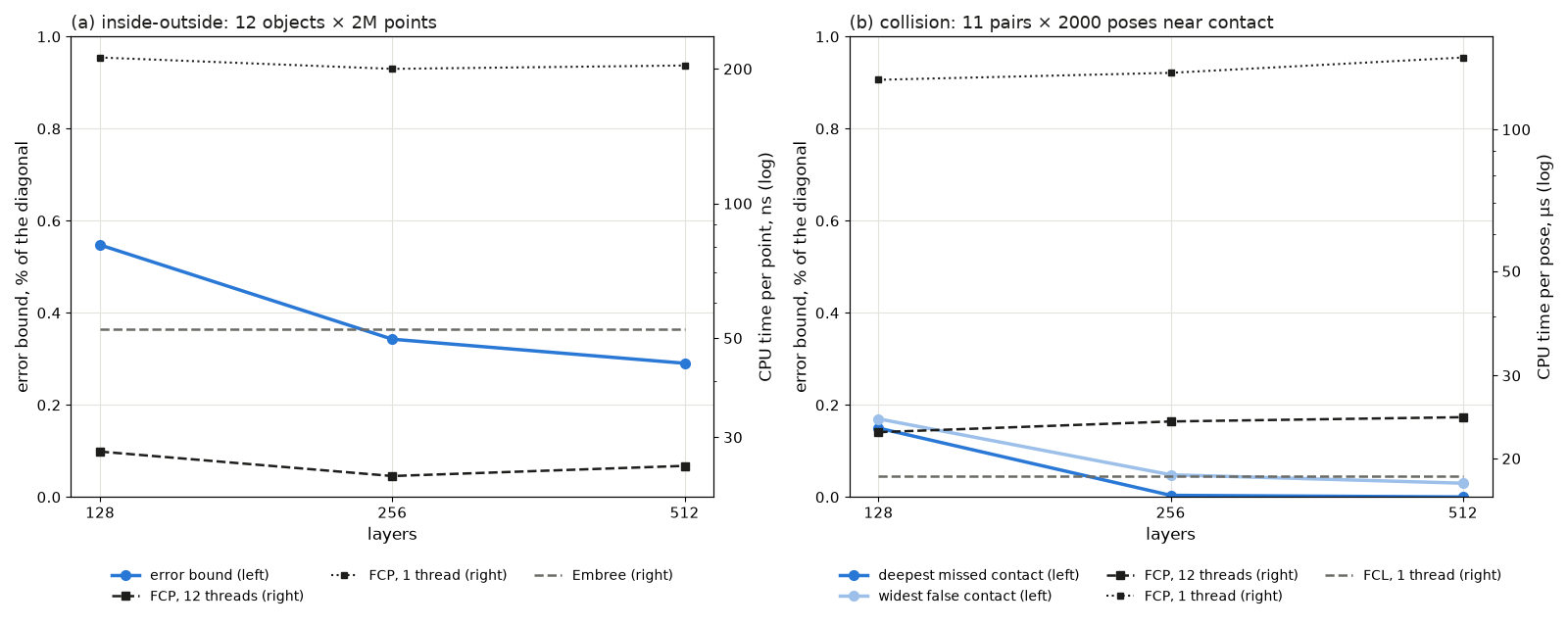
| 128 | 0.20 (0.55) | 0.55 | 1.25 | 27.9 | 212 | 52.4 | 0.15 | 0.17 | 99.86 | 22.7 | 127 | 18.4 |
| 256 | 0.27 (0.99) | 0.34 | 0.64 | 24.6 | 200 | 52.4 | 0.00 | 0.05 | 99.94 | 24.0 | 132 | 18.4 |
| 512 | 0.37 (1.76) | 0.29 | 0.37 | 25.9 | 204 | 52.4 | 0.00 | 0.03 | 99.95 | 24.5 | 142 | 18.4 |
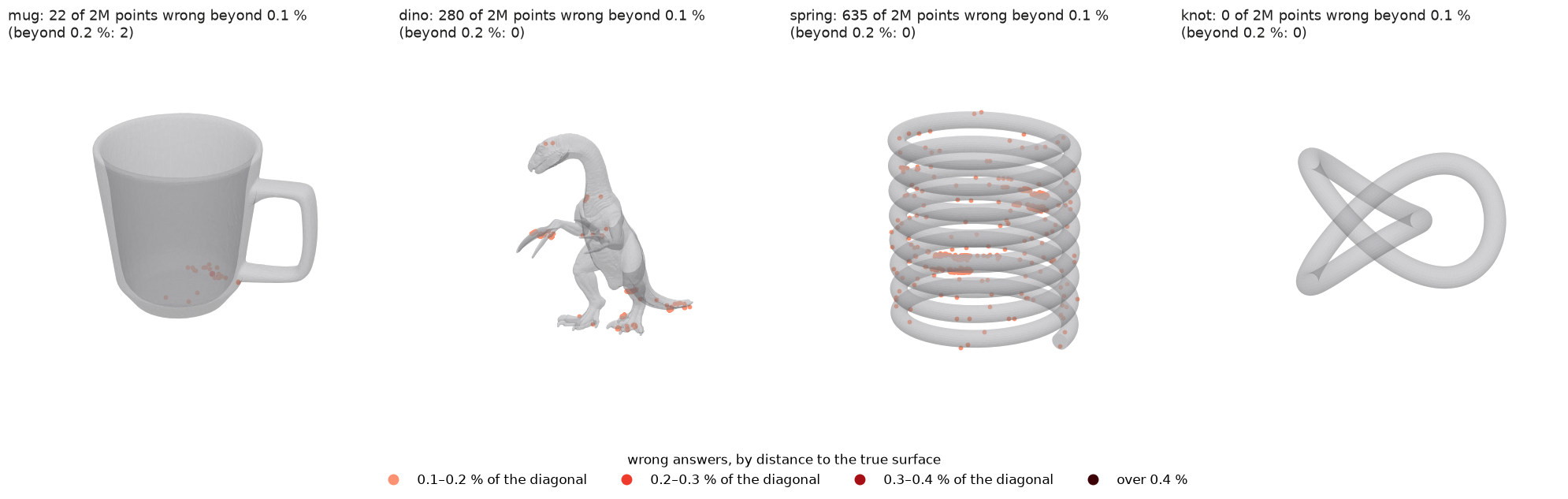
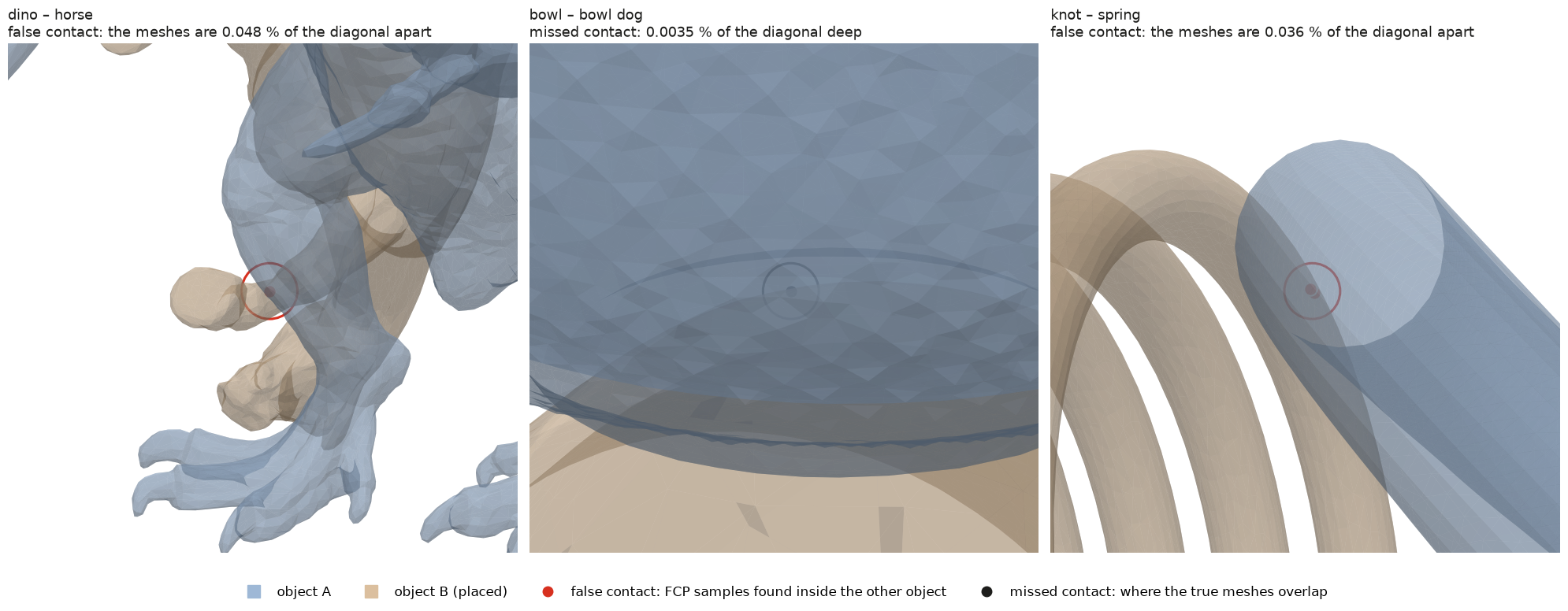
Points: FCP answers in 24.6–27.9 ns per point with 12 threads, 1.9× faster than Embree on the same CPU, at every layer count. The error bound is 0.29–0.55 % of the diagonal; its worst case comes from a handful of points at sharp details and pieces that start or end between two slices (below), and it falls with the layers; the share of wrong answers near the surface falls 1.25 → 0.37 %. Collision: no missed contact deeper than 0.15 % of the diagonal and no false one wider than 0.17 % at 128 layers (0.05 % from 256 layers); 99.86–99.95 % of poses correct. On the CPU, FCP is not faster than FCL at this sampling: 22.7–24.5 µs per pose with 12 threads and 127–142 µs with 1, against 18.4 µs for FCL on one thread; with every other sample FCP takes 6.2–7.0 µs (99.86–99.92 % correct, misses up to 0.62 %). FCP's collision speed-up is a GPU result (the poses in one batch).